Showing posts with label social media. Show all posts

You say you want a revolution?

How would you change the world in 2010? We've never been more connected, at our fingertips are social networking services that can potentially broadcast your thoughts to hundreds of people, and maybe even thousands more you've never met. Surely this should herald a new era of activism, with causes spreading contagiously, rapidly exposing injustice and bringing it to the attention of those who can right it.

Or maybe not. Malcolm Gladwell has just written a contrarian article, arguing that whilst the inherently weak ties in social networks have the power to spread ideas, they can change very little. His argument is that revolutions require serious commitment, and that spreading the word is not the same as getting involved. And I agree.

Mass movements aim to use the power of social proof to win over uncommitted minds, by demonstrating that "we" are more numerous, and more passionate than "them". This can be very effective in a democracy, where winning over a majority of the electorate will award power to your cause via the ballot box. But what if you're challenging a much more powerful, deeply entrenched, and potentially violent establishment - like the theocratic dictatorship of Iran?

In the summer of 2009, there was a lot of wishing thinking about Iran's "Twitter Revolution". The "Green" national consciousness movement, so the theory went, was growing contagiously, sidestepping state media controls and winning the hearts and minds of decent Iranians one tweet at a time. Sadly, this proved to be a total myth.

The problem was, whilst the #iranelection tweets proved very effective at spreading the message of discontent, most of the audience wasn't actually in Iran, and so was powerless to affect events. Inside Iran, a study of archived tweets suggests that Twitter was primarily used to propagate news, rather than recruiting and galvanising strategically important individuals.

The difference between bonding and bridging is a pet subject of mine. Twitter is a bridging network of weak ties, whilst Facebook networks combine a few strong bonds with a much larger number of weak ties. Revolutions, however, require the steadfastness of the very strongest of bonds - where you know your fellow activists personally, and trust them with your life (in the case of Iran, literally).

Gladwell's argument is that if you’re taking on a powerful and organized establishment activists need to arrange themselves into a hierarchy of ultra-strong bonds - which will maintain morale, keep discipline and allow the movement to act strategically. There is another factor though, which I was surprised he didn't mention, which concerns how change actually happens.

In 1989, revolutions swept through Eastern Europe. In each case, the revolution was preceded by popular protests, which grew progressively in size and militancy. The difference between Europe in 1989 and Iran in 2009 is that the army, sensing the popular mood, came out on the side of the demonstrators. Once the public knew the state's ability to suppress the movement violently was over, revolution was inevitable.

The lesson to draw from these successful, relatively bloodless (pre-Internet) revolutions is that fermenting a revolution requires swinging the key influencers behind your cause. These individuals are not journalists, or university professors, authors or movie stars - but the army lieutenants and police captains that give the orders to cadres of troops and paramilitary police. It is absurd to think that such individuals will be watching screens, ready to be swayed by a barrage of tweets. They'll be on the streets marshalling roadblocks, motivated by the fear of lethal retribution if their part of the line fails.
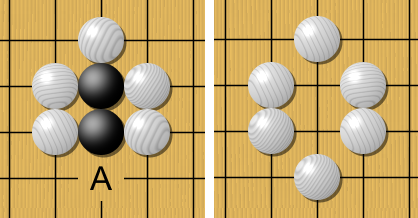
Place stone at A to capture black
The only way to influence such people is through the bonds that matter more to them than their chains of command. Perhaps their best friends, most trusted colleagues, or their wives, or sons or daughters. In this respect, fermenting a revolution is more like a game of Go. It is not about the number of stones you play (or friends or tweets you make). Instead, it is about applying pressure to key individuals. To truly win, you must surround those you seek to influence, and turn them to your side. Such is the wisdom of the ancients.

Fortunately, most of us will never need to risk our lives challenging a despotic regime, but the same principles apply to any intransigent opponent, (albeit with far lower stakes). For instance, how can a loosely assembled group of fans force out the disastrously inept current owners of Liverpool football club? Certainly not by tweeting, petitions or protest marches.

The lesson is to effect change, you need to find some way to win over the key influencers - in this case the banks who own the debt used to buy the club, and those who might be tempted to refinance it. You need to convince them that the incumbent owners are leveraged-buyout chancers and second-rate businessmen, and offer them an alternative they'll view as a better investment.

So, if you know anyone at the RBS's Bad Debt division, please give them a nudge. As for the rest of us, we'll just have to continue shouting our protests.
And cross our fingers.

You have no influence: how to use it

Where do policies come from?

Does a sweaty government minister abruptly wake in the middle of night exclaiming "We must do this!". Or are they contrived by a panel of senior politicos as they draft their election manifesto? Or perhaps the cabinet has a suggestion box, and every week one is drawn at random to be enacted. Or maybe a conversation on a Mediterranean yacht is transcribed into a memo a few days later, and then amplified into draft legislation by a gaggle of mandarins eager to impress their boss.

It's a serious question - where do the ideas that come to shape our world actually come from?
The public - or the political elite? Which would you prefer?

Consider the recently launched Robin Hood Tax campaign. The basic idea was elucidated by Yale academic James Tobin, who proposed adding a levy on currency transactions to deter speculation. That was 1972, since then the idea has marinated and evolved in the minds of various economists. Some governments have even talked about enacting it into law, but only if everybody else does it.

So where do policies come from? Say you think the Robin Hood Tax is a great idea, how would you get it into law? Perhaps one day you'll find yourself on a sunny yacht with the Lord High Chamberlain, you get on well, you have a chat, he likes the cut of your jib, he just loves your new idea... a few weeks later, it's on the order papers.

But more than likely, you're outside the inner circle. It's a small world, but not THAT small. You're still too many hops away from the high and mighty. No waterside pow-wows for you. Know your place, citizen.
Most individuals have no influence.
And yet, collectively, individuals have huge influence. Together, we elect governments.
So policies come from us, after all?
Not quite.

Voting in an election is like choosing which door to walk through. One door might be safe and sturdy looking, one might be slick and slimy, another might be downright scary. You pick your door and enter. You do not get to position and decorate your own door. Slightly inflexible, but them's the rules.

So how can you use your choice to further the prospects of something you believe in? For instance, you could ask your prospective MP if they will support the Robin Hood Tax. If they say yes, vote for them. If a majority of your fellow constituents agree, you have your representative. If not, no-one really cared. It must have been a half-baked idea anyway. Get over it.

So there's two challenges: first, you've got to convince the majority of your fellow electors this is an issue worth caring about. Talk about it. Individually, tweets and blog postings are insignificant, they won't change the world, but they might get your friends thinking. Who might mention it to a relative, who tells their partner, who...

The second challenge is holding your representative to account once they're elected. Here again, social media can help. If they renege, ensure every mention of their name is accompanied by #RHTliar, let your fellow constituents know they've been betrayed. These days politicians are very sensitive about their personal brand; they know if it's sullied, they'll be out of a job.

And if, collectively, you can get enough of the MPs to keep their word... job done.

Social media offers you the chance to say to politicians:
We'll decide on the ideas, you just implement them.
If you want it to, it might just work.

Twitter FeedRecent Twitterings

    Do we share an interest?

    c o n t a c t m e @ j a r o n c o l l i s . c o m