Time to End Rotten Boroughs

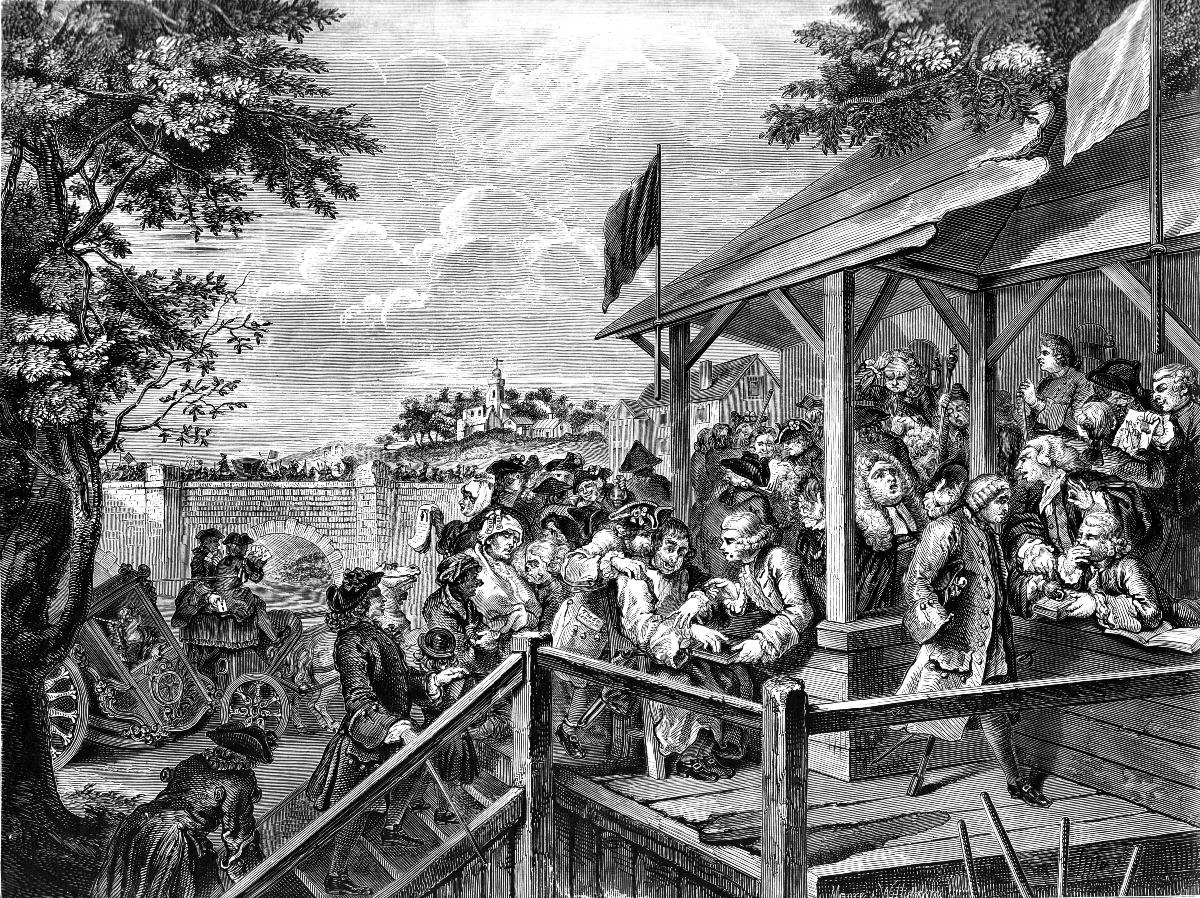
William Hogarth's satire The Polling (1758), shows the few electors being 'encouraged'
In the classic Blackadder the Third episode "Dish and Dishonesty" foppish Prince George faces ruin if parliament votes to cut his income. But the government's majority is 1, so if he can just win a crucial vacant seat, his income will be safe. Fortunately, the crucial seat of Dunny-on-the-Wold is a rotten borough - it has a single voter. Win over that voter, and the government will be foiled.

It sounds farcical, but until rotten boroughs were abolished in 1832, that was how the system worked. A few people, wielding a disproportionally huge amount of influence. It made no sense, but up until the 1830s, it suited the establishment of the time.

Then in 1832, rotten boroughs were replaced, and in their place came Safe Seats.

Safe seats give an illusion of democracy, an election occurs, leaflets are published, hustings are organised - but just like the rotten boroughs of yore, the result is never in doubt. In the 2010 general election, the predictability of safe seats meant that of the 650 seats contested, only votes cast in about 100 key seats really mattered. According to the Institute for Public Policy Research, the decisive seats were determined by just over 460,000 voters, 1.6% of the electorate.

OK, we've moved on a bit from the era of the rotten borough. Now instead of a handful of rich landowners holding the balance of power, it's the selection committees in 100 seats, who choose the candidates to go before the 1.6% of our fellow citizens, who by accidents of social geography happen to cast the decisive votes.

Why? Because just like in the 1830s, the system works this way because it suits those in power.

But on May 5th, you have a once in a lifetime opportunity to change this system.
By voting in the electoral reform referendum. And saying YES.

The referendum offers us a choice, to change to a more proportional system called Alternative Vote (AV), or keep the current system, First Past The Post (FPTP).

Choosing AV would mean that instead of targeting the 100 'battleground' seats, the political parties will be forced to come up with better thought-out, more inclusive policies - ones that will appeal not just to their traditional supporters, but also to supporters of other parties, whose 2nd and 3rd preferences may prove crucial. AV means no more wasted votes - everyone's vote will count.

Or we could stick with the idealogical headcount encouraged by FPTP, which forces everyone to decide which tribe they want to belong to every 5 years. In many parts of the country, only one party has EVER been elected. But is that really democracy? No wonder so many of us are disenchanted with politics. Disagree, and depending on where you live, your voice just won't be heard.

In FPTP, the minority can govern the majority (look back over the last 30 years).
But in AV, because of the 50% rule, it will be the majority that governs the minority.

It's time to finally get rid of rotten boroughs, and replace them with something fairer.
Vote YES to AV.

10 reasons why I didn't create Facebook

The Social Network movie tells a striking story: how a 19-year old student wrote some software, founded a company, and changed the world. But why was it that Mark Zuckerberg was the one to create it, and not you or me?

It's an interesting question. You might dismissively answer that Zuck just "got lucky" - but in doing so you'd be missing the opportunity to understand what makes a successful entrepreneur. In fact, a psychologist might say that those choosing to believe "he got lucky" are actually just trying to protect their own egos, to avoid acknowledging their own limitations. Namely that a 19-year old with few formal qualifications was not just more technically-savvy than the millions of us who call ourselves technologists, but also more business-savvy than the millions who consider themselves businessmen.

So why didn't you, or I, with all our educational advantages and years of professional experience create Facebook? Here's 10 reasons to ponder:

1 We weren't hungry enough

By the time Zuck sat down to write Facebook in 2004, I was already a start-up veteran. I'd been the fifth employee in a pioneering London dotcom, helping to build and run the company's services platform. But I became worn out, and by 2003 I'd left to go travelling for 5 months, which proved to be an awesome adventure - so much so that when I returned to work, my plan was simply to earn enough go travelling again. At this point in my life, I didn't want to change the world, I wanted to see the world.

2 We weren't itchy enough

Most successful ventures start because their founders have an itch they need to scratch, before realising that other folks also have the same problem, and there might be a business in providing a solution. For Zuck, the itch was how to connect with fellow students better (and a Napsteresque desire to share news and music throughout a dorm). Once he realised there was a demand for an online version of the paper 'face books' his college printed, he went ahead and built one. What's bothering you today?

3 We weren't visionary enough 

Almost everyone's first online experience is having a conversation. Networks are inherently social, that's obvious, we use them to talk to others. Nevertheless, it wasn't until Facebook arrived in the UK that I started to understand Social Networking, and its distinguishing feature: on the internet you can talk to anybody, but on a social network it's just your friends. As a consequence, the services you build upon a social network are specialised: to share the stuff that binds you together. If I'd asked you in 2004 to draw the internet in 2010, would it have looked anything like this?

4 We weren't courageous enough

There are two ways to work in a startup: found one yourself, or join the team at an existing venture. For the past decade, I've done the latter; eschewing the harder, riskier and more stressful path of the founder, for the slightly less stressful role of senior techie. You have to be very driven to consider swapping the security and rewards of a job you've worked so hard to achieve for the uncertainty of founding something new, which might not even work.

5 We weren't connected enough

In our hubris, it's easy to over-estimate what we can achieve on our own. But eventually life teaches us that who you know is indeed just as important as what you know. What's a better investment? Spending 1000 hours reading everything about this year's hottest new technologies, or spending 1000 hours attracting an awesomely-connected mentor like Sean Parker? These days being connected doesn't mean you have WiFi, it means you have access to the kind of influential people who can help you change your world.

6 We weren't located well enough

What have Apple, HP, Oracle, Sun, Yahoo, Google, Facebook and Twitter all have in common? They all grew up in the same small corner of California. (And here's the reasons why). Such is the area's cachet, even the 6 month old Facebook moved from Boston (no high-tech wilderness) to Palo Alto, to be better connected. I suppose I could have moved there too, but chose to stay near my friends in London, where the startup and VC community is smaller and much less vibrant.

7 We weren't skilled enough

Or perhaps more accurately: we lack the right balance of skills. You might be an expert at designing and implementing software, but how much do you know about incorporating a company, or contract law, or tax allowances, or sales and marketing? I came away from university knowing all about how computer systems work - from low-level memory registers right up to complex artificial intelligence applications, but next to nothing about how to build up businesses. Then in the years subsequently, I kept on deepening my technical knowledge. Perhaps the moral here is avoid specialising too deeply, and instead look to broaden your horizons, and become a creative generalist instead.

8 We weren't adventurous enough

Being an entrepreneur is more difficult than being an explorer, because there is no map to guide you, and the blank spaces aren't visible until you stumble across them. Say, in 2005, you were inspired to follow in the footsteps of Facebook - would you attempt to compete for the same niche or try to pioneer something new? Would you have spotted the possibilities of a brand new niche for a real-time web-scale bridging network? Twitter found that one. As Steve Blank says: companies execute business models, startups search for new ones. There's always another blank space to find, if you're adventurous enough.

9 We weren't determined enough

There is a passion in creative artists that makes them strive to create new works, because creating things is their calling. As Paul Graham says "the most important predictor of success is determination". But I have been content to earn rather than yearn, deploying my skills to further others' projects, and being well paid for doing so. This is just how the world works, the determined few hire the talented many to make their visions happen. Are you sitting comfortably?

10 We weren't motivated enough

A quick straw poll of friends reveals virtually everyone has their own pet idea or hobby project, but few are actively considering turning it into a business. So those ideas will be left to marinate inside their heads, until someone more driven comes up with the same idea, and goes that bit further: filling in the company paperwork and putting in the late nights. Ever noticed there's a lot more late night hacking in 'The Social Network' movie than soliloquies? The real pioneers just do it.


So the reason why I didn't create Facebook has little to do with personal characteristics, otherwise I might as well have written an article called "10 reasons why Usain Bolt runs faster than me". Instead, the reason neither of us created Facebook is a result of where we've come from, our attitudes, and - crucially - the life decisions we've made along the way. Most people, me included, tend to choose the comfortable path. Perhaps that's why our culture respects entrepreneurs highly, because in our comfy, cosseted modern life, they're amongst the rare few willing to leave their comfort zones to actively seek out new struggles.

So whilst the opportunity to build Facebook is past, new opportunities still lurk undiscovered in the blank spaces, awaiting the determined and the adventurous. Perhaps you already have all the skills you need, perhaps you don't need any.

And that's why I didn't create Facebook. What about you?

You say you want a revolution?

How would you change the world in 2010? We've never been more connected, at our fingertips are social networking services that can potentially broadcast your thoughts to hundreds of people, and maybe even thousands more you've never met. Surely this should herald a new era of activism, with causes spreading contagiously, rapidly exposing injustice and bringing it to the attention of those who can right it.

Or maybe not. Malcolm Gladwell has just written a contrarian article, arguing that whilst the inherently weak ties in social networks have the power to spread ideas, they can change very little. His argument is that revolutions require serious commitment, and that spreading the word is not the same as getting involved. And I agree.

Mass movements aim to use the power of social proof to win over uncommitted minds, by demonstrating that "we" are more numerous, and more passionate than "them". This can be very effective in a democracy, where winning over a majority of the electorate will award power to your cause via the ballot box. But what if you're challenging a much more powerful, deeply entrenched, and potentially violent establishment - like the theocratic dictatorship of Iran?

In the summer of 2009, there was a lot of wishing thinking about Iran's "Twitter Revolution". The "Green" national consciousness movement, so the theory went, was growing contagiously, sidestepping state media controls and winning the hearts and minds of decent Iranians one tweet at a time. Sadly, this proved to be a total myth.

The problem was, whilst the #iranelection tweets proved very effective at spreading the message of discontent, most of the audience wasn't actually in Iran, and so was powerless to affect events. Inside Iran, a study of archived tweets suggests that Twitter was primarily used to propagate news, rather than recruiting and galvanising strategically important individuals.

The difference between bonding and bridging is a pet subject of mine. Twitter is a bridging network of weak ties, whilst Facebook networks combine a few strong bonds with a much larger number of weak ties. Revolutions, however, require the steadfastness of the very strongest of bonds - where you know your fellow activists personally, and trust them with your life (in the case of Iran, literally).

Gladwell's argument is that if you’re taking on a powerful and organized establishment activists need to arrange themselves into a hierarchy of ultra-strong bonds - which will maintain morale, keep discipline and allow the movement to act strategically. There is another factor though, which I was surprised he didn't mention, which concerns how change actually happens.

In 1989, revolutions swept through Eastern Europe. In each case, the revolution was preceded by popular protests, which grew progressively in size and militancy. The difference between Europe in 1989 and Iran in 2009 is that the army, sensing the popular mood, came out on the side of the demonstrators. Once the public knew the state's ability to suppress the movement violently was over, revolution was inevitable.

The lesson to draw from these successful, relatively bloodless (pre-Internet) revolutions is that fermenting a revolution requires swinging the key influencers behind your cause. These individuals are not journalists, or university professors, authors or movie stars - but the army lieutenants and police captains that give the orders to cadres of troops and paramilitary police. It is absurd to think that such individuals will be watching screens, ready to be swayed by a barrage of tweets. They'll be on the streets marshalling roadblocks, motivated by the fear of lethal retribution if their part of the line fails.

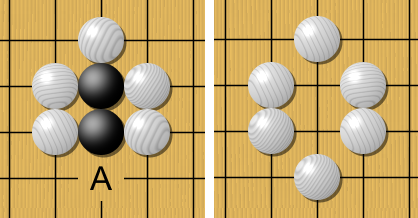
Place stone at A to capture black
The only way to influence such people is through the bonds that matter more to them than their chains of command. Perhaps their best friends, most trusted colleagues, or their wives, or sons or daughters. In this respect, fermenting a revolution is more like a game of Go. It is not about the number of stones you play (or friends or tweets you make). Instead, it is about applying pressure to key individuals. To truly win, you must surround those you seek to influence, and turn them to your side. Such is the wisdom of the ancients.

Fortunately, most of us will never need to risk our lives challenging a despotic regime, but the same principles apply to any intransigent opponent, (albeit with far lower stakes). For instance, how can a loosely assembled group of fans force out the disastrously inept current owners of Liverpool football club? Certainly not by tweeting, petitions or protest marches.

The lesson is to effect change, you need to find some way to win over the key influencers - in this case the banks who own the debt used to buy the club, and those who might be tempted to refinance it. You need to convince them that the incumbent owners are leveraged-buyout chancers and second-rate businessmen, and offer them an alternative they'll view as a better investment.

So, if you know anyone at the RBS's Bad Debt division, please give them a nudge. As for the rest of us, we'll just have to continue shouting our protests.
And cross our fingers.

How I discovered barefoot running

I am not a trendwatcher. Maybe more of a trendcoral; comfortably attached to a lovely rock, letting the cultural sea wash over me. My currents are carefully selected RSS feeds, rich in memes and intriguing new ideas, from which my polyps pick out interesting morsels, which I slowly assimilate to become more colourful. What interests me are not the current affairs of common knowledge, but the emerging concepts that people in disparate communities are beginning to talk about - ideas that are beginning to spread. Last year, several instances of one such concept floated past and tantalised my polyps: it went by the name "barefoot running".

Being a keen hiker, I knew about Vibram soles, so my interest was piqued when I read about their weird-looking new product called the FiveFingers - which was actually made for your toes - and which looked more like a comedy rubber foot than a shoe. The motivation, it transpired, was that walking or running barefoot was supposedly more "natural", and paradoxically less likely to result in injuries. I mentally filed that discovery away under "Intriguingly Crazy Ideas That Might Just Work". And went on to read something else.

Later that year, my polyps picked up the barefoot meme again, this time in Wired. So what prompted Wired to write about it? As so often with emerging ideas, there's a wellspring that unleashes the river, and in this case it seemed to be a recent book by Chris McDougall, called Born to Run.

When I looked into the book, the story became more interesting still. It seemed that going barefoot wasn't just a bunch of footwear refuseniks, it was a subculture. And one that had generated enough interest to keep the book in the bestseller lists for months. I was sufficiently intrigued to buy a copy, it turned out to be an excellent book, and I resolved to try it for myself. (I'm glad I did, but that's another story)

And as the idea spread, I began to see articles in mainstream newspapers. In July 2009, The Guardian was reviewing barefoot trainers and asking whether it was a craze or a fad. By October, the New York Times was reporting on the barefoot boom and summarising research into barefoot running published in recent Sports Science journals.

The barefoot meme continued to spread, it even became a metaphor. Going barefoot was cited as a zen habit - a minimalist way of living: of travelling light whilst remaining aware and present.

By January 2010, a study of barefoot running was published in Nature. Looking back at my Google Reader history I sense that once it became an area of legitimate scientific study, barefoot running seemed to gain a new level of media acceptability. Subsequent articles would discuss the pros and cons of going barefoot, rather than dwelling on its quirkiness, or pondering whether it was just a craze.

Perhaps then, this is how ideas form. They start with a few enthusiasts talking amongst themselves, which if popular enough, attracts a small subculture around them. As the idea spreads, community members start writing books and articles, some of which will be picked up by more general media and distributed to wider audiences. Until eventually, outsiders like us stumble across them...

The difference between Facebook and Twitter

Once upon a time, it was obvious: Facebook was that portal with your friends' personal profiles, whilst Twitter was that quirky stream of collective consciousnesses.

Now, Facebook is effectively a feed too. So are they just different channels? Although many Twitter clients can be configured to automatically post Tweets to Facebook too, allowing users to maintain two separate social networks (like work and play), I don't know many who actually use it that way.

Digging deeper, a recent study of the two social networks found that 87% of Americans knew about Twitter, and 88% knew of Facebook. Yet only 7% of Americans actively use Twitter, whilst 41% actively use Facebook. Worldwide, Facebook currently has over 500 million members, whilst Twitter has around 100 million members.

So why is Facebook so much more popular than Twitter?
Here the nature of the connections within each social network may hold the answer.

There's an idea within sociology called Social Capital, which seeks to measure the value of the connections in an individual's social network. The idea being the greater the quality of your social connections, the greater your productivity and opportunities. "It's not what you know, it's who you know."

Social network researchers refine this idea into two subconcepts: bonding social capital and bridging social capital.

Bonding (also called Closure) is the tendency of like-minded individuals to form connections amongst themselves. The community that emerges from these interactions is densely interlinked, and social proof and reputation become powerful forces.

Bridging (also called Brokerage) is the function performed by people whose relationships bridge across structural gaps in social networks. Brokers introduce people from previously unconnected social networks, and help information flow between disparate communities.


These concepts can be seen in this diagram, taken from Wikipedia. A densely linked community on the left, with a couple of brokers bridging the gap to a smaller community on the right.

Facebook is a bonding network, dominated by strong ties between friends and families. Whereas by encouraging weak ties, Twitter is designed to be a bridging network. Users can follow distant strangers, and high quality information can quickly spread between closed communities by the retweets of brokers.

Most social networks tend to contain many more bonds than bridges. So the reason why Facebook is much more popular than Twitter might be because, collectively, our urge to bond with friends is stronger than our desire to bridge with relative strangers.

On reflection then, it's probably best not to tweet about what you've had for breakfast; but it might make a friend on Facebook smile.


The Games of Life

First we were encouraged to buy. Then we were encouraged to contribute. Next: will we be encouraged to play?

A decade ago, e-commerce was the hot area for new startups. Once it became possible to buy almost anything online, the new new thing became contributing and sharing content. Now that field is pretty packed, what's next?

One interesting trend I've been following is the increasing use of game mechanics to drive user activity online. In some communities, points, leaderboards and achievements are being used to reward high quality contributions. Others are more competitive, with players motivated purely by earning new achievements.

At this point, you might be asking: why would anyone want to create a game around a service? For some, games are pastimes, fun distractions for idle hours. Why would a business waste time and money providing games that cost the players nothing to play? Personally, I can think of at least 4 motivations for game providers - educating players, capturing intentions, encouraging new experiences, and influencing behaviour.

Educational games sugar the pill of learning with an entertaining activity, a staple of schools for decades, you're bound to have played one. But recently a new breed has been created by activists seeking to virally spread a message through social media. One of the best examples is Darfur is Dying, a 2006 newsgame that puts the player in the role of a persecuted refugee. Such games aim to provide a thought-provoking experience that will propagate the message and perhaps even galvanise players into action.

Intentional games, by contrast, are more business-like. They involve a trade, with the player revealing their current intentions in exchange for some micro-reward. For instance, John Battelle talks about checking into a state of mind - a more explicit version of what we currently all do when we use search engines.

Experience games try to get players out of their homes and doing things they've never done before. Foursquare and Scvngr are good examples, where players are encouraged to explore their local environment, undertake new activities and discover things they've probably never noticed before.

Finally, behavioural games seek to encourage positive behaviour. The motivation here will be familiar to anyone who has read Nudge - the recent manifesto of libertarian paternalism. By way of illustration, see game designer Jesse Schell's excellent presentation on what might happen when games invade real life. And if you think that's far-fetched, just watch the hilarious EpicWin app trailer.

It's coming, after all, life is the ultimate game.

Remembering Istanbul

5 years ago tonight, Liverpool played AC Milan in the Champions League final. It was to be one of the greatest games of football ever played. This is what I remember...

Let me tell you a story of young team
Who were sent far away from their home
To fight for their fans in that country
And also the red folks back home.


Prelude

It was half-time on a cold December night, and we were lost in a desert.
We needed to score three goals in the 2nd half against Olympiakos. The ruins of our season stretched before us like a barren landscape. Then when all seemed lost, two rookie strikers appeared and the captain conjured a wonderstrike.
And then we noticed something, faraway on the horizon, an oasis?

At the time, even our captain didn't believe the oasis was real, but we had little else to walk towards. When our thirst took us past Leverkusen, the oasis came closer. Then our brilliant general masterminded the improbable conquest of Juve and Chelsea's mighty legions. And so it was that one night in May we finally reached the lush oasis that had once seemed so impossibly far away.

We sang and stared longingly at its silvery surface, mesmerised by our accomplishment. But still it shimmered, unreal, like a figment of a half-remembered dream. One final act was required - that would distinguish glory from mirage.
We needed to beat AC Milan.


1 - Requiem for a Dream

They put them in a champions' division
Sent them off to a far foreign land
Where the fans swarm around in their thousands
And there's nothing to see but the sand.


Sadly I wasn't in Istanbul, so I would watch the game in the legendary Extra Time Bar in London. Obviously a lot of people had the same idea, I arrived 90 minutes before kick-off and had to queue to get in, all 3 floors were already almost packed to the rafters. This was not a place for the agoraphobic.

We watched Sky's pre-match build-up with growing anticipation, we had plenty of dreams and songs to sing. When the line-up appears there's a buzz of excitement as Rafa's attacking intentions are revealed. The Italians won't know what's hit them! Someone nearby starts humming the Ring of Fire, which spreads contagiously until everybody joins in.

We kick off amid a roar of noise, but Djimi immediately gives the ball away and fouls his man trying to recover. We can scarcely believe it when Maldini hammers in the resulting cross. Imagine a party, everyone's having fun, when the music suddenly stops and someone announces the host's mother has died. Our carnival atmosphere deflates like a runaway balloon.

A minute later our resolve has returned. Hands are clapped. Come on you Reds!

But Milan are making our limited attacks look pretty feeble, spearing balls into our defence left, right and centre. With Sheva and Crespo constantly threatening to burst past the last man, our previously rock solid defence now seems made of plasticine. Then from a corner Crespo has a free header - Luis Garcia clears off the line. Bloody hell!
Eyes are rubbed, heads are shaken.

By now the wheels had well and truly fallen off our attacking plan, and Harry Kewell limps off to be replaced by Vladi Smicer. Plenty of phrases spring to mind now, but 'strength in depth' is not one of them.

Our unimaginative attacking, with Baros marooned up front, contrasts embarrassingly with our opponents, whose midfield moves forward as a unit, with two quick outlets scaring us witless. Poor passing and lack of movement means the Reds can't keep the ball, and when Milan have it we're chasing shadows.

Worries increase when Kaka bursts forward, and plays through Sheva who finishes expertly. We breathe again when the sympathetic linesman gives us the benefit of the doubt and flags him offside. Nervous smiles all round.

Suddenly Garcia breaks into the box, and Nesta blocks it with his arm.
Expectant shouts! But no pen! With more Reds watching the Ref than Kaka, Milan sweep forward again, Sheva beats Djimi, squares to Crespo who couldn't miss even in a Chelsea shirt. Oh bollocks.

And it's all gone quiet over there.

With few tackles to worry about Milan move into exhibition mode.
Kaka slides a long pass behind Carra's despairing lunge - no flag this time - and Crespo chips it in with his first touch. Oh fuck.

On Sky, Andy Gray announces "Game well and truly over".
Around me there are no shouts of disagreement, just bowed heads.
Hundreds of red-shirted people stand silently about me.
It's like being at the Pope's funeral.

We had reached the oasis, knelt at the water's edge, bowed and kissed the silver surface... and tasted sand.

The half-time whistle goes, and our dreams lie in ruins.
Having come so far, we curse the mirage's cruel capriciousness.

With no Reds highlights to watch and plenty of adverts, most fans seem to spend the interval sending text messages. Here's a quick summary of what I received:
Fuck. Gutted. WTF! Screwed. Shit. Bollocks. All over.

Basically, we are dead.


2 - Testament to a Miracle

As we lay on the battlefield dying, dying, dying
With the blood rushing out of our heads, of our heads
As we lay on the battlefield dying
These were the last words we said...


"Remember Garcia's against Juve?" ... Oh yes.
"Carra against Del Piero!" ... Awesome.
"The Kop against Chelsea!" ... Oh mate.

At the interval the mood is changing from gloom to rueful resignation as drinks are ordered and memories are replayed.

It might only have been a mirage, but it had led us on a wonderful journey. It had made us believe such adventures were possible again. How lucky we were to catch sight of that oasis when we were stumbling so hopelessly in the wilderness.

Whilst the dream might be in ruins, we were here to support our heroes and 45 minutes of our season remained. We had our pride to play for. No one was leaving, the bar remained packed, but subdued.

Coverage from the Ataturk resumes, and news comes in: Finnan is off and Didi is on – we’re going to a back three, just like we did against the Greeks. Heads nod. Interesting.

But the 2nd half doesn't get off to an auspicious start. Jerzy spills a simple cross. Groans. Milan humiliated Barca 4-0 in the '94 final, and we're now battling to avoid the same shame.

But now there's something different about the Reds coming forward. Instead of isolated raids, now we have 6 men in enemy territory, with commando captain Stevie G at the front-line harassing the enemy. A bit of pressure and the ball begins to ricochet off white shirts. One chance falls to Xabi who rifles a shot just wide.
A consolation goal looks distinctly possible.

Our momentum is interrupted by another Djimi Traore mistake, Kaka bursts through and Sami brings him down just outside the box. Sheva blasts in the free-kick, but Jerzy pulls off an amazing late low save.

That was the tipping point, when everything changed.

From their corner we win the ball back. Didi and Xabi work it neatly forward before picking out Riise. He crosses - it's blocked, he tries again and Super Steve heads into the top corner. Get in!
We explode into noise; we've an hour's pent-up emotion to release.
Captain Fantastic pumps his arms, "Come on! Come on!" he yells to his troops. We need little motivation. "Oh when the Reds! Go marching in!" You know the words.

And we'd just started singing the Fields of Anfield Road when Hamann feeds Vlad on the edge of the box - and holy fuck - it's 3-2!
"Come on! Come on!" I scream at the screen. "This is football!"

We're at fever pitch now, strangers are shaking each other by the shoulders, geeing each other up, the noise is deafening.
"Come on! Come on! We can do this!"

Now the Reds really are working like lions and fighting like tigers.
We hustle the ball off a white shirt and flood forward again.
Baros backheels to Gerrard, and he's clean through!
But Gattuso hacks him down!
It's as clear a penalty as night follows day.
Bedlam breaks out as the ref points to the spot.

Xabi Alonso steps up amid a din of clapping, cheering and shouting.
Shouts of anguish turn into delirious cheering as Dida saves only for Xabi to hammer in the rebound.

3 goals in 6 minutes. What a comeback!
As one, our massive crowd is jumping, dancing, singing, yelling, embracing.
The place is in ferment. "Come on! Come on!"

And there's still 30 minutes to play. Next, Riise goes for glory.
Dida saves, but we shout out John Arne's song anyway. The carnival atmosphere is back. YNWA echoes around the stadium and into homes and pubs around the world.

But back come Milan, and disaster! Jerzy spills an easy catch at Sheva's feet. Amazingly Djimi gets back to clear Sheva's shot off the line!
Around me, a hundred voices sigh in relief. Shamefully, Djimi doesn't have a song of his own for us to sing, so a chorus of his name has to suffice.

But now Milan aren't finding it so easy any more. Didi continues to intercept their probing passes and harass those who venture too close.

It's end to end now, a classic Stevie G Hollywood ball finds Garcia, but he can't control it. 30 seconds later Jerzy hesitates, Sheva gets in behind and is about to square to Kaka to score, when Carra appears from nowhere to pick the cross off his feet with a last-gasp tackle.

10 minutes left, and the bar now looks like a marathon finishing line, a crowd of haggard looking fans in red Reebok jerseys, faces drenched with sweat. For a few minutes the Reds produce a bit of "Ole!" football and we can get our breath back.

Oh no! Here they come again, Sheva carves us apart - whoa! thank fuck - there's Carra with another brilliant slide tackle 10 yards out. From the corner Stam flashes a header across goal - Kaka gets a touch and we're almost solksjaered - but it flashes wide. I notice a lot of my fellow fans now have hair reminiscent of Doc Brown in the Back to the Future movies.

Injury time finishes with Milan in the ascendancy. We seem to have settled for extra time; maybe Rafa fancies our chances against Milan's tired old legs.

Mind you, by now those in Red shirts aren't looking too spritely either.
Our dynamism isn't helped by our inspirational captain having to play at right-back. But it's a wise move by Rafa. In the space of 10 minutes Super Steve saves enough of our bacon for a super-sized fry-up.

Out of the blue a long ball arcs over Traore, and Newcastle-reject Tomasson half-connects and slices wide. Ouch. This is torture.

After 15 minutes of mostly Milan pressure, Smicer collapses with cramp.
I know exactly how he feels.

The 2nd period begins with a few forays into Milanese territory, but we don't commit enough forward so Milan win the ball back easily and continue to dominate possession.

10 minutes to go, and Carra stretches to make yet another last-gasp clearance before collapsing clutching his groin. Worldwide, every Red holds their breath. Stevie G moves to centre-back until our hero limps back onto the pitch. A minute later, Carra stretches to make another crucial interception. What a hero.

6 minutes to go. And Pirlo almost breaks through but Didi blocks him just outside the box. It's now obvious that the Reds are knackered, and that we're not saving ourselves for a final minute sucker-punch cavalry charge. We'll defend what we have.

Then, in the 118th minute, all was lost.

Finally one of Milan's crosses makes it through, and Sheva's bullet header from 8 yards is brilliantly saved by Jerzy.
But the ball falls at Sheva's feet.
And I saw him fire in the rebound from 2 yards out.
Gutted, my insides lurched. We'd lost. After all that, we'd been solksjaered.

I can barely believe my eyes when the replay shows Jerzy throwing out a hand to deflect Sheva's shot over the bar. It's the most astonishing save I've ever seen. A true wondersave. Unbelievably against all the odds, we are still alive.

Our incredible reprieve lifts us and the superb Didi Hamann charges forward, and Vlad wins a free-kick in the very last minute. We sing Riise's song, hoping for a fairytale ending. But not this time.

The final whistle blows for one of greatest cup finals of all time.

Diego Maradona comments afterwards:
"Even the Brazil team that won the 1970 World Cup could not have staged a comeback with Milan leading 3-0."


3 - Coda

So, how confident were you?
Did you believe?

We were facing a team of superstars who'd already won this competition on penalties.
At the Milan fans’ end.
Against Dida, the penalty save expert.
And we'd missed 7 of our last 15 penalties.
Including one less than an hour ago.
So, no problems then.

Of the 22 players on the field, 21 look like they're eating lemons.
But one is wearing a wide grin and having a laugh with his coaching staff: Jerzy Dudek. Bizarrely, Carra runs over to Jerzy and starts waving his arms. We'd soon discover what that was all about.

Meanwhile in London the noise is back. We shake each other shouting 'Believe!', clench fists and kiss badges. Huddles are forming mimicking the players in the centre circle. All around expressions range from stunned, to petrified, to expectant, to manic.
Here we go.

Serginho steps up first.
And amazingly Jerzy begins to run through an aerobics routine on his goal-line! This obviously brings back bad memories for the Brazilian, who completely bottles it and puts the ball into row F.
We react with restrained cheers; mindful our lads are hardly penalty kings either.

Our first kick is Didi versus Dida.
In contrast to Jerzy, Dida looks like he's been turned to stone, a bloody huge stone mind you.
Didi missed a pen in Cardiff, but he's obviously been practicing with the national team, he puts his kick into the corner.
Gasps of relief.

Next up is Pirlo, a dead-ball specialist.
Now Jerzy's dancing on the line. Pirlo does the Aldo shuffle but chokes, Jerzy guesses right and saves his weak shot.
Our wild cheers segue into a high volume rendition of "We've got a Big Pole in our Goal!"

Next up is Djibril Cisse.
Seven months ago he was minutes away from having a foot amputated.
Now he completes the fairytale comeback by sending Dida the wrong way.
Now we're really celebrating.

Now it's Tomasson's turn.
He ignores Jerzy's impression of a man guiding in a jumbo jet and blasts it home.

Riise steps forward next.
We expect him to blast it, but the huge Brazilian goalie gets his fingertips to the placed shot.
Doh! Heads are slapped, hair is ruffled.

Kaka takes the next kick.
Jerzy does the Brucie homage wobbly legs routine this time. But Kaka ignores him and contemptuously knocks it in the top corner. Ooooh.

There are nervous gasps - we know the next kick is crucial one.
And up steps Vlad, for what is probably his last kick in a Red shirt.
Gerrrinthere! He secures lifetime cult hero status by sending Dida the wrong way.
After jumping up and down for a while we remind everyone in earshot that he's Czech, great and really good friends with Patrik Berger.

And so Sheva must score.
Our small huddle holds its breath.
Jerzy stretches, wobbles, then crouches…
The European Footballer of the Year drives it straight and hard...
Jerzy has already dived, but flicks out a hand...

How can I possibly describe what happened next?

Basically, the place went berserk.
Jumping, screaming, cheering and yelling.
An explosion of noise.
Then came the random hugging of strangers.
Then came the exclamations of achievement.
Then came the singing.
I can do the experience pathetically little justice.
You had to be there.

What a night.

We'd created a legend, and several hundred million around the world witnessed it.
We saw Stevie G kiss the Cup, and found the dream was real after all.


Twitter FeedRecent Twitterings

    Do we share an interest?

    c o n t a c t m e @ j a r o n c o l l i s . c o m